How much waste we actually recycle
Ask the Expert: Jo Gilroy (Head of Sustainability).
We asked our Sustainability expert ‘How much of the waste that goes into recycling bins ends up at a recycling plant? And how many of those plants are in the UK?’ And here’s what she told us…

Sustainability Expert – Jo Gilroy Twitter – @JoannaGilroy
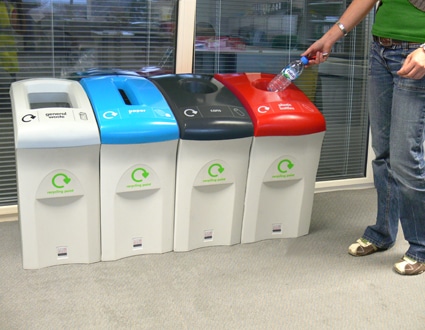
This is the million dollar question and the absolute truth is that no one knows exactly how much we actually recycle and also how much waste or recyclable material is sent overseas. This is because as a Nation, we do not track how material flows through our economy on a detailed scale, a consequence of our ‘take-make-waste’ approach to living. What we do have, are a series of well estimated guesses.
According to the latest figures published by DEFRA, recycling rates for household waste are around 43% (as of 2013). However, this figure relates to the amount of recyclable material managed by local authorities and so largely does not include commercial recycling rates. We do know that in 2012, the total waste produced from commercial and industrial activities was 47.6 million tonnes, but with businesses using multiple different waste management providers, and with no central reporting system for measuring what actually gets recycled, it is anyone’s guess as to how much of this material was a) recycled and b) recycled in the UK. Our fundamental problem is that we do not know, and what we do not actively and accurately measure, we cannot effectively manage and in this case, improve.
It is estimated that around 1 million tonnes of waste is sold overseas for incineration, or refuse derived fuel (RDF) as it more commonly known. Millions of tons of recyclable material are also sold overseas, primarily to China, supporting the development of the overseas recycling infrastructure. With the current state of affairs, are we not missing out on an invaluable opportunity to drive change and develop our own infrastructure?
On a more hopeful note, change is happening. More and more businesses and individuals are waking up to, and acting on, three key realizations:
- Waste is the biggest and most costly environmental challenge business and society faces today.
- It is no longer acceptable not to know what we waste and where this material actually ends up.
- It is an incontrovertible fact that we must care about waste.
At Bunzl Catering Supplies (BCS) we have taken these realizations to heart through our Waste to Resource Partnership with Closed Loop Environmental Solutions (CLES) and Simply Waste Solutions (SWS). Together, we are looking to create an accurate picture of the volume of packaging material delivered to customers, actual volumes recovered, recycled and remanufactured into usable products, supported by credible and detailed data. Only through such effective measuring will we be able to effectively manage the transformation of waste into a resource.

Post Details
Latest Posts
How to avoid a norovirus outbreak with The Oxivir Body Spillage Kit
As if the chilly weather, dark mornings and runny nose weren’t enough to deal with
Bunzl Catering Supplies headline sponsor the inaugural waste2zero Awards
On Wednesday 6 December, Bunzl Catering Supplies headline sponsored the inaugural waste2zero Awards, held at